Private cloud with OpenStack
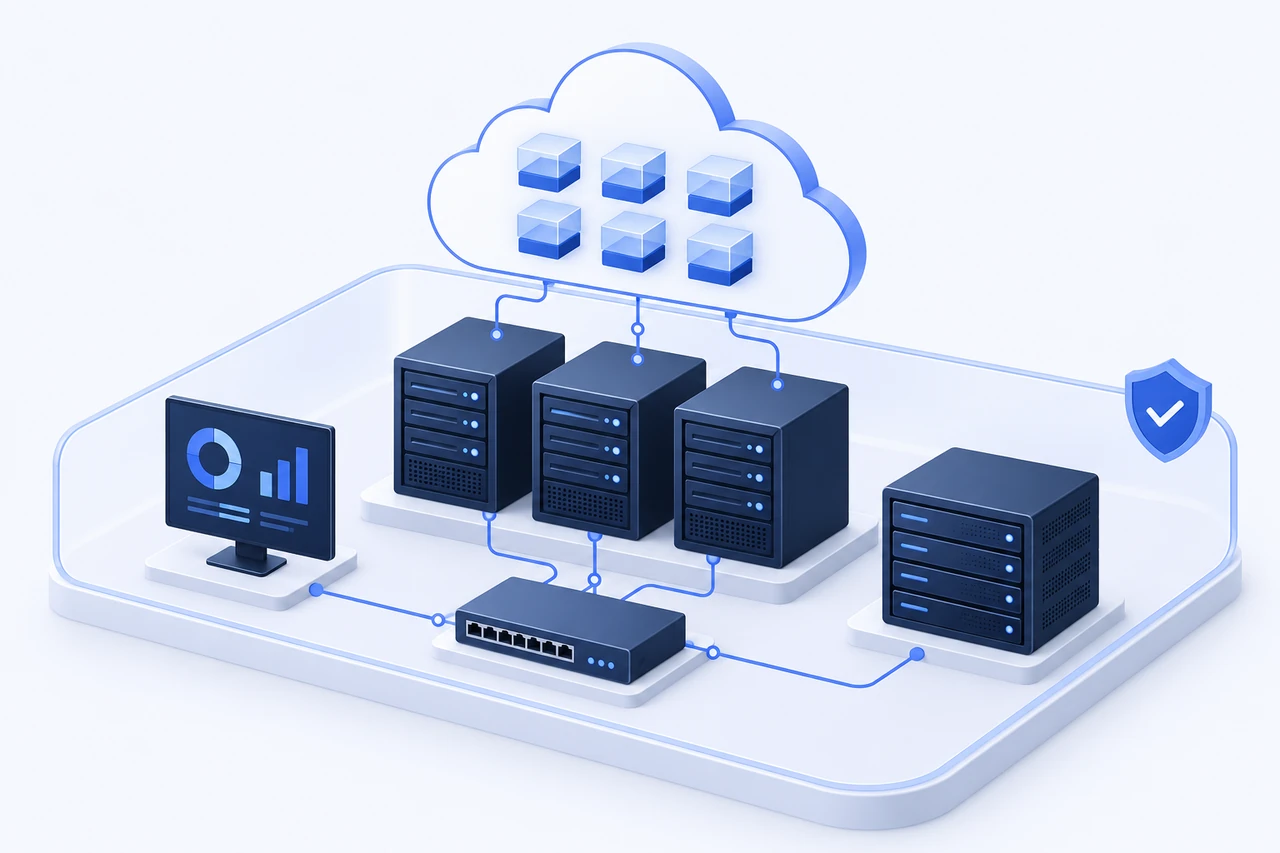
For enterprises, software companies, and compliance-driven organizations, public cloud platforms often introduce unpredictable egress fees, vendor lock-in, and regulatory uncertainty. We engineer, deploy, and maintain openstack private cloud Calgary businesses leverage to run scalable on-premise cloud infrastructure on their own terms. By running your compute, networking, and object storage on open-source OpenStack architecture, your organization retains complete physical data residency in Calgary while delivering self-service virtual machines and API-driven automation to internal teams. Take full control of your infrastructure without ongoing per-core hypervisor license fees.
Why it matters
Guaranteed physical data sovereignty in Calgary
On a public cloud, your data sits on a provider's hardware subject to foreign legal reach and unilateral terms of service changes. An OpenStack private cloud runs on physical servers you choose, in Calgary facilities you select. For businesses with strict contractual, legal, or industry data residency obligations, it provides an auditable, verifiable answer to data location questions.
Predictable infrastructure economics without surprise bills
Public cloud costs rarely remain stable; they grow with every gigabyte of egress bandwidth, API request, and storage snapshot. An OpenStack private cloud turns fluctuating operational cloud expenses into predictable hardware assets and transparent hourly maintenance costs.
True self-service cloud APIs without proprietary lock-in
OpenStack delivers the modern cloud operating model—programmable APIs, automated provisioning, software-defined networking, and multi-tenant isolation—on standard open-source software. You are never locked to one vendor's proprietary ecosystem.
Who this is for
- Calgary enterprises with sensitive client, financial, or engineering data that must remain strictly within Alberta data residency boundaries.
- Software companies spending thousands of dollars monthly on public cloud compute that could operate far more cost-effectively on owned server hardware.
- Organizations seeking complete operational independence from US-based cloud hyperscalers and foreign legal jurisdiction mandates.
- IT teams wanting self-service multi-tenant VM provisioning, software-defined networking, and programmable cloud APIs on private infrastructure.
- Businesses migrating away from expensive VMware vSphere enterprise agreements toward an open-source, vendor-neutral cloud operating platform.
What is included
- Architecture design for core OpenStack services: Nova compute, Neutron networking, Cinder block storage, Glance image service, and Keystone identity
- Deployment on enterprise server hardware in your own Calgary facility or local co-location data center
- High-availability control plane configuration with Galera database clustering, RabbitMQ messaging, and Pacemaker fencing
- Software-defined networking with Open Virtual Network (OVN), floating IPs, VLAN segmentation, and tenant overlay networks
- Ceph distributed storage integration for scalable, redundant block storage, VM boot volumes, and S3-compatible object storage
- Multi-tenancy configuration, department project quotas, role-based access control, and self-service Horizon web dashboard
- Comprehensive infrastructure health monitoring, Prometheus and Grafana telemetry, and coordinated OpenStack release upgrades
- Automated infrastructure deployment scripts (Kolla-Ansible) enabling reproducible configuration and simplified day-2 lifecycle maintenance
Process and written scope
1. Workload Sizing & Architecture Review
We analyze current and forecasted workloads, compute core-to-RAM ratios, storage IOPS, and network throughput to design a redundant node architecture balancing compute, storage, and control plane nodes.
2. Network Fabric & Control Plane Deployment
We configure bonded 10G/25G physical networking, management VLANs, and deploy a 3-node highly available OpenStack control plane using containerized Kolla-Ansible architecture.
3. Compute Hypervisors & Ceph Storage Integration
We provision KVM compute nodes, integrate distributed Ceph storage pools, configure tenant networking overlays, and test automated VM provisioning via CLI and Horizon dashboard.
4. Workload Migration & Operational Runbooks
We assist in migrating virtual machines from legacy environments, establish automated database and state backups, configure alerting thresholds, and train your staff on operational runbooks.
Practical guide & common pitfalls
Common Pitfall: Deploying OpenStack on non-redundant controllers
Attempting to run OpenStack control plane services on a single node creates a brittle infrastructure where a single service crash halts all API calls and VM scheduling. We mandate 3-node controller clusters with distributed quorum for MySQL/Galera and RabbitMQ.
Troubleshooting Guide: Network MTU mismatch in Neutron overlays
Encapsulation protocols like Geneve or VXLAN add packet overhead (typically 50 bytes). If physical network switches do not support jumbo frames (MTU 9000), packets fragment, causing severe TCP throughput collapse. We verify end-to-end MTU alignment during deployment.
Storage Best Practice: Ceph CRUSH map and fault domains
Ceph storage requires careful failure domain planning across server racks and power circuits. We configure CRUSH maps so that block replicas are distributed across distinct physical failure domains, ensuring storage availability during hardware maintenance.
Lifecycle Management: Automated deployments with Kolla-Ansible
Manual OpenStack installations frequently fail during subsequent release upgrades. By containerizing OpenStack services using Kolla-Ansible, we ensure services are isolated, version-controlled, and capable of in-place rolling upgrades.
Rates
$115–$150 per hour
Private cloud with OpenStack in Calgary. Fixed-scope project quotes are available on request, and scope and cost are confirmed in writing before work starts.
Frequently asked questions
What hardware is required to run an OpenStack private cloud?
A production high-availability OpenStack cluster typically starts with 3 controller nodes, 2 or more compute nodes, and 3 or more storage nodes running enterprise-grade server hardware with redundant 10G or 25G networking.
How does OpenStack compare to Proxmox VE?
Proxmox VE is ideal for single-tenant server consolidation and smaller clusters (up to tens of hosts). OpenStack is designed for multi-tenant, cloud-scale infrastructure where departments require self-service APIs, programmable networking, and software-defined storage.
Can we migrate existing virtual machines to OpenStack?
Yes. We support converting and migrating virtual machines from VMware vSphere, Hyper-V, and standalone KVM hosts into OpenStack Cinder volumes with minimal cutover downtime.
How is OpenStack consulting billed?
Work is billed hourly at our published $115 to $150 rate with a detailed written scope of work and milestones established before work begins.
Can an OpenStack private cloud run in a Calgary co-location facility?
Yes. We frequently deploy and maintain OpenStack infrastructure in local Calgary data centers and co-location facilities, providing high-bandwidth connectivity and secure physical housing.
Often paired with this
Database administration
PostgreSQL and MySQL tuning, replication, backups and query performance work.
Security & hardening
Firewalls, SSH lockdown, patch cadence and audits that keep business systems out of the news.
Backup & disaster recovery
Automated backups, tested restores and a documented recovery plan, so a failed disk is a procedure, not a scramble.
Talk to us about private cloud with openstack
Describe your setup and what is bothering you. You get a straight answer on scope and cost, not a sales script.